A man who dived into the ocean of physics and discovered many secrets of nature, yet lived a life marked by personal tragedy and quiet resilience.
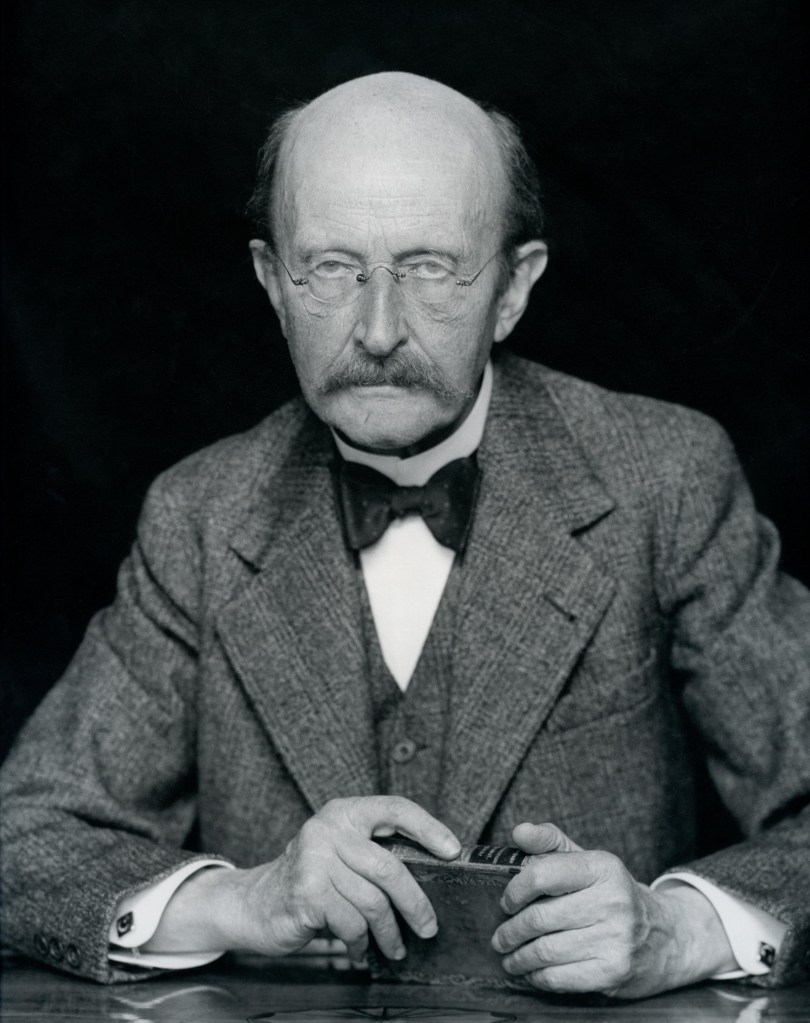
While I was reading a book, “A Short History of Nearly Everything” by Bill Bryson, I came across the tragic life of Max Planck. The man who spread the light of his knowledge to the world, but his own life was covered with darkness. Max Planck was born in 1858 into an intellectual German family. At a very young age, he was very dedicated to science. At the age of 21, he earned a doctorate and became a professor at the University of Berlin. Planck was a very traditional thinker who valued traditional thinking. Once he believed that physics was almost completed, there was nothing new to discover. His professors discouraged him from physics, saying: “There is nothing new to dicover”
The blackbody problem was a major question mark on physic which was not solved by classical physics. The theory predicted that objects should radiate infinite energy at high frequencies. This was physically impossible and became known as the “ultraviolet catastrophe”. Planck introduced the concept that energy is not constant, but instead emitted in discrete packets called quanta. This theory revolutionised quantum physics and he became the father of quantum theory. How can we forget about one of the most famous constants in physics: Planck’s Constant. The Planck’s Constant(h) is the bridge between the macroscopic world like us and the microscopic world like atoms, subatomic particles and photons, etc. There are many other major discoveries by planck’s like Planck’s law of blackbody radiation and thermodynamic contributions.
Despite huge contribution to science, his life was not a blooming garden. His life was filled with many unfortunate events. His beloved first wife died early. In 1909, the younger of his two sons was killed in the First World War. He also had a twin daughter whom he adored. One died giving birth. The surviving twin went to look after the baby and fell in love with her sister’s husband. They married and two years later, she died in childbirth. In 1944, when Planck was eighty-five, an Allied bomb fell on his house and he lost everything—papers, diaries, a lifetime of accumulations. The following year, his surviving son was caught in a conspiracy to assassinate Hitler and executed. While the world celebrated his ideas, his personal world kept collapsing.
Planck at first did not accept the ideas about his discoveries. But he opened the door, which he was uncomfortable walking through. Planck didn’t want a revolution. He wanted a solution. He introduced energy quanta as a calculation tool. He didn’t think that this was going to change quantum physics forever. For Planck, uncertainty was a mathematical inconvenience, not a philosophical truth. His greatest contribution forced him to question the very order he trusted.
In 1918, Max Planck awarded with nobel prize in physics for the contribution of physics by discovery of energy quanta. Units named to honour him like Planck’s length, Planck Time, Planck mass, etc. When physicists talk about the limits of reality, they still speak in Planck’s language. There are many miseries in this world that come upon us. There are many pains in this world that are inevitable and Max Planck is the prime example of it. Yet, Planck bore his suffering and spread his light of knowledge to the world. His legacy will be remembered by many future generations.
 Veeru Patel
Leave a comment